Uzi - Sub-Machine Gun (SMG)
 
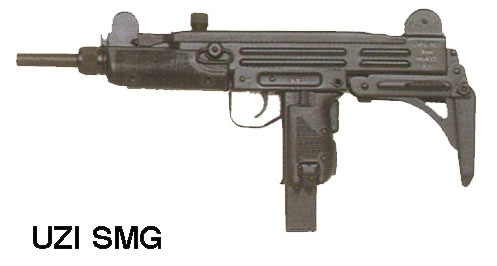
The first variant, the standard  Uzi, was introduced in the mid 1950's and almost immediately become a symbol of the tough and young fighting county of Israel.
 
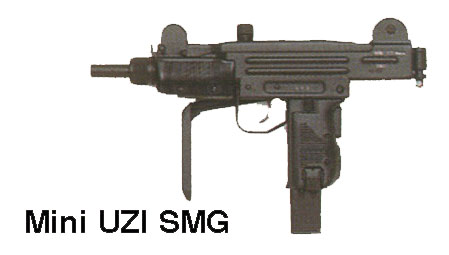
In the mid 1980's IMI presented the new member of the Uzi family the Mini Uzi. Few years later after gaining considerable combat reputation it was offered globally.
 
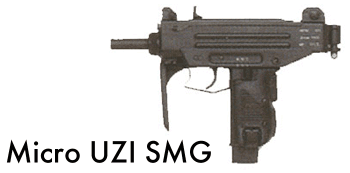
The smaller member in the family, the Micro Uzi, was introduced in the early 1990's. It was intended mainly for security in handgun frame weapon yet with a more potent fire power. Another role intended for the Micro Uzi was as a Personal Defense Weapon (PDW) for airborne and armored crews personnel.
 
Another version was also presented the Uzi Pistol which is basically a semi auto only Micro Uzi and lacks the Mini Uzi folding stock.


The Uzi is a compact weapon and makes use of a number of features which have since found their way into other SMG designs. It has a square outline and is made from steel pressings riveted and spot-welded together. It uses a blowback mechanism but has a bolt that actually wraps around the end of the barrel. The bolt face and firing pin are some 95mm back from the front edge of the bolt, the rest of which surrounds the chamber and rear of the barrel. Slots are cut into the bolt to allow empty cases to pass through when being ejected, and by using this wraparound method a sufficiently massive bolt can be made that takes up little space. The return spring sits round a guide rod above the level of the barrel, which extends forward of the chamber. 

The Uzi and its variants have been in service in at least 26 countries, from 50s to this day, and have been produced by seven manufacturers around the world.  Although replaced in military front-line service by more powerful assault rifles, the Uzi remains in use by the police and soldiers in non-combat roles. It one of the oldest and famous firearms family in the world. 


Selection of Uzi
 
The IDF commissioned two local designers to independently develop weapons that would meet their needs, both named after their creators.  The first was a fairly traditional-looking gun designed by Major Chaim Kara, head of the IDF's Science Corps light weapons division.  The second gun was developed by a local youngster who was moving rapidly up through the ranks and who seemed to possess a genius for weapons design Uziel Gal.  Both designs were further refined to meet the sophisticated demands of the IDF, especially the Kara.   In 1951, the rival guns were submitted to the army for competitive testing.

Both guns utilized a wrap-around bolt and blowback action, which reduces the overall weapon size to achieve compactness.  This type of bolt is common today, but was innovative in the 1950's.  The precision 9mm Kara had only eight main parts, making it easy to field strip.  However, since it was built to very fine tolerances, it was expensive to manufacture and could not tolerate Middle Eastern sand and dust without jamming.

After twelve Karas and five UZIs were placed on rigorous trial in 1951, the UZI emerged as the winner because of its ability to tolerate dust and grit without jamming, as well as its ease and low cost of manufacture.

From 1951 until 1955 some eighty preproduction UZIs were issued to selected units for field testing.  After further refinement, the UZI we know today emerged in 1955 and was put into service. In the
Sinai Campaign (1956) the gun proved its reliability and began a long, successful career.  Further enhancements were added during service, such as a new folding metal stock that replaced the older fixed wooden stock in 1967.  The weapon was also licensed to be produced by FN, the renowned Belgian weapons company.


A large pistol grip extends beneath the centre of the body, with the trigger assembly in front of this. The ammunition feed is actually through the butt, and 25- or 32-round magazines are inserted from below the grip, a system that helps the firer replace magazines quickly, especially in darkness. A plastic shroud below the front of the receiver provides a foregrip. Early models had a fixed wooden stock, although most Uzis have since been fitted with a folding metal item. The grip is positioned roughly at the point of balance, which makes the weapon much easier to control when firing bursts. Safety features include a combined safety/selector lever above the left side of the grip, and a button on the rear of the grip, which must be squeezed before the bolt or trigger are free to move. There is also a catch on the cocking handle slide that prevents the bolt moving forward and firing a round if it is released accidentally before reaching the trigger sear. 

The Uzi is reliable and surprisingly accurate; it has been used by the armed forces of over 20 nations and has also been licence-built by FN in Belgium. Israeli troops have fought numerous battles with this tough little gun, and even though it has been replaced in many formations by the Galil assault rifle it will remain in service for years to come. Israel Military Industries has not rested on its laurels however, and a number of variants have been developed. The Mini Uzi is some 95mm shorter than the standard model, has a much simpler wire folding stock, and has compensating slots cut into the top of the muzzle. In virtually all other respects it is identical to the basic model. 

An even smaller version is the Micro Uzi, which at 250mm in length is almost the same size as a large handgun. It retains a wire folding stock, and the bolt has a heavy tungsten insert to slow the rate of fire to a reasonable level. The Micro Uzi is too small and short-ranged for the battlefield, but it makes for an effective, easily concealed bodyguard and personal defence weapon.Another version was also presented the Uzi Pistol which is basically a semi auto only Micro Uzi and lacks the Mini Uzi folding stock.


Standard Uzi
Mini Uzi
 
 
Micro Uzi
Uzi Pistol
 
 
Models
Uzi SMG
Mini Uzi SMG
Micro Uzi SMG
Uzi Pistol
Ammunition
9mm Parabellum
Operation
Blowback, firing from open bolt position (OBP)
Blowback, firing from closed bolt position (CBP) or OBP
Blowback firing from CBP
Mode of firing
Semi- automatic, Automatic
Semi-automatic
Magazine capacity
20, 25, 32
Rifling
4 grooves, 1 turn in 254 mm
Twist 1 turn in: (mm)
254
Muzzle velocity (m/sec)
400
375
350
345
Rate of fire (rd./min.)
600
CB-1700, OB-950
1700
-
Weight (gr.)
W/o magazine
3500
2650
2000
1700
Empty magazine 25 rd.
200
Loaded magazine 25 rd.
500
Dimensions (mm)
Overall length
650
600
486
240
With stock folded
470
360
282
-
Barrel length
260
197
134
115
Sights
Front
Post
Rear
Aperture "L" flip type
Aperture
"U" notch
Sightline radius (mm)
310
230
180
 
 
Uzi Gal, the inventor of the Uzi submachine gun, has died in Philadelphia of a long illness, he was 78.


09/09/2002

Gal died Saturday and will be buried Thursday in Kibbutz Yagur, a collective farm near Haifa where he grew up. 

The Uzi submachine gun, invented in the 1950s and used by the Israeli army for the first time during its Sinai campaign in 1956, has became a mainstay of secret services from Jerusalem to Washington. 

Gal was born in Germany in 1923 and immigrated to Israel in 1936 after Adolf Hitler came to power. 

In recent years, Gal was developing a new type of pistol that was to be marketed in the United States. Israel's Yediot Ahronot daily reported that the new weapon was to "create a revolution in the international weapons market" but gave no details.