Ambutank (Sherman Armored Ambulance)


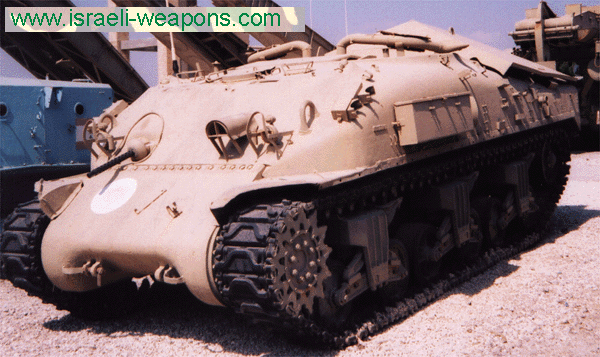
VSS variant


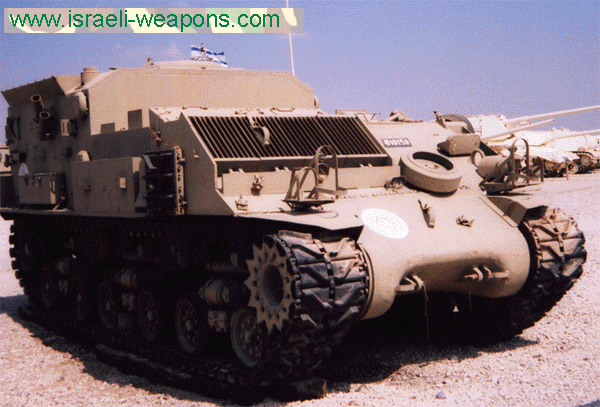
HVSS variant


At the end of the 60's, the IDF realized that there is a growing need for a medevac armoured vehicle for fast evacuation of wounds from a tough terrain field. The vehicle had to withstand enemy fire, and be able to provide maximum protection and medical treatment to wounds.

Instead of investing great amounts of money and resources in developing such vehicle, it had been decided to use an existing platform, thus shortening the development process.

The Sherman 's battle tank platform was chosen for the task. The Sherman was largely available and the specific model was the M4A1, which was used in the past as a basis to the M5A1 model.

In order to utilize sufficient amount of space which is critical to the vehicle's main purpose, the engine was transferred from the tank's rear part to the front, leaving large room for the task of wound treating. The hull could now house a medical crew and 4 stretch beds.

Workshop unit 650 of the ordnance corps was assigned the task of the conversion of the Sherman platform into what would later be called the Ambutank.

VSS model

In 1969, the first prototype of the Ambutank was introduced. This was the Ambutank VSS. It served in the IDF at the outset of the War of Attrition, at the southern front and at the northern sector of the Suez Canal .

HVSS model

At a later stage, the Ambutank was built on a Sherman platform with a Kamin's engine, and wide Horizontal Volute Suspension System ( HVSS) . The HVSS had a special hatch on its floor which enabled it to pick up victims without endangering the crew.

The Ambutank HVSS was produced in large scales, and was used during the War of Attrition and Yom Kippur War at the Egyptian front along the Suez canal .


Ambutank VSS
Ambutank HVSS
Crew
5
4-5
Armament
 
7.62mm
Weight
30 tons 
30 tons
Engine
380 hp
460 hp