|
|
|
M113 (Bardehlas)
|
|
| |
|
| |
| |
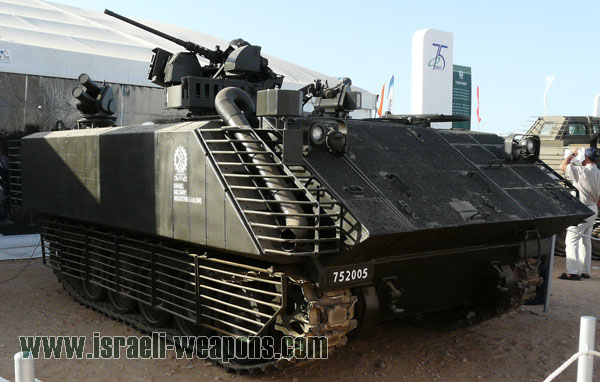
The M113 APC was the first modern "battle taxi"; developed to transport infantry forces on the mechanized battlefield. It is fitted with a 2 stroke six cylinder Detroit diesel providing power through a 3 speed automatic gearbox and steering differential. The main armament is a single .50 Cal heavy barrel machine gun, and the secondary armament is a single .30 Cal machine gun. The M113 is built of aircraft quality aluminum which allows it to possess some of the same strengths as steel at a much lighter weight. This distinct weight advantage allows the M113 to utilize a relatively small engine to power the vehicle, as well as carry a large payload cross-country. The vehicle is capable of "swimming" bodies of water.
The Bardehlas (or M113) was introduced in Israeli service in 1972 and has been obtained in huge numbers. Estimates are 5500 of all marks. Although the vehicle had more than sufficient mobility, it lacked adequate armour protection. Because the hull was made from aluminium, once hit by an RPG (rocket propelled grenade) fires raged furiously and there was almost no escaping the vehicle. The M113 earned its unofficial name Zippo and crew preferred to ride on the vehicle’s roof, taking the risk of exposing themselves to enemy fire rather than staying put in the flammable confines of the Bardehlas.
|
| |
| |
Original US M113 Models |
| |
M113 Armored Personnel Carrier (1960)
The original M113 Armored Personnel Carrier (APC) helped to revolutionize mobile military operations. The vehicles were able to carry 11 soldiers plus a driver and track commander under armor protection across hostile battlefield environments. More importantly, the new vehicles were air transportable, air-droppable, and swimmable, allowing planners to incorporate APCs in a much wider range of combat situations, including many "rapid deployment" scenarios. The M113s were so successful that they were quickly identified as the foundation for a family of vehicles. Early derivatives included both command post (M577) and mortar carrier (M106) configurations.
M113A1 Armored Personnel Carrier (1964)
The first major upgrade came in 1964 with the introduction of the M113A1 package which replaced the original gasoline engine with a 212 horsepower diesel package. The new power train was soon incorporated into the existing vehicle family as the M113A1, M577A1, and M106A1, as well as several new derivative systems. Some of these new derivatives were based on the armored M113 chassis (the M125A1 mortar carrier and M741 "Vulcan" air defense vehicle) while others were based on an unarmored version of the chassis (including the M548 cargo carrier, M667 "Lance" missile carrier, and M730 "Chaparral" missile carrier).
M113A2 Armored Personnel Carrier (1979)
Continuing modernization efforts led to the introduction of the A2 package of suspension and cooling enhancements in 1979. As with previous enhancements, these upgrades resulted in further proliferation of the FOV. |
| |
| |
History |
| |
The M113-family was developed from M59 and M75 by Ford and Kaiser Aluminium and Chemical Co. in the late 1950´s. The vehicle is capable of: amphibious operations in streams and lakes; extended cross country travel over rough terrain; and high speed operation on improved roads and highways.
Since their initial introduction in 1960, M113-based systems have entered service in more than 50 countries. The systems have been modified into more than 40 identified specific variants, with many times that number of minor field modifications. Many of these modifications have been developed by foreign governments to meet their specific national requirements. While some older M113 derivatives are being retired and removed from selected inventories, other FOV members are being upgraded, reconfigured, and introduced as entirely new systems.
More than 80,000 M113 Family of Vehicle (FOV) systems have been produced. New M113 FOV systems are being built while existing chassis are being upgraded to modern configurations.
One of the lessons learned so costly at the Yom Kippur War (1973) and Lebanon War (1982) was the vulnerability of the armored personnel carrier (APC) in the modern battlefield. The first M113 APC were sold to Israel in 1970 and after that M113 is the main APC in IDF. |
| |
| |
|
Inside the Israeli M113
|
| |
These photos taken from http://www.geocities.com/yosidov
|
| |
Special thanks to Itzik Malkin for his help. |
| |
|
| |
General
Length 480 cm
Width 265 cm
Height 215 cm
Maximum weight 14,061 kg
Personnel capacity 2 + 11
Fuel tank capacity 95 gallons (360 liters)
Performance
Speed on land 66 km/h
Speed in water, with track 5.8 km/h
Cruising range 483 km
Engine
Make and model Detroit Diesel 6V53T
Displacement 5.2 liter
Fuel Diesel (DF2)
Rated horsepower 275 hp
Transmission, Automatic
Make and model Allison X200-4B
Type Hydrokinetic
Steering Hydrostatic
Brake type Multiple wet plate
Running Gear
Suspension Torsion bar
Road wheels 5 per side, 61 cm diameter
Track type Steel single pin, detachable rubber pad
Number of shoes 63 left, 64 right
Track pitch 15.2 cm
Track width 38 cm
Shock absorbers 3 per side
Wheel travel 22.9 cm
Electrical System
Generator
Amperes 200, 300 optional
Volts, dc 28
Batteries 4, type 6TL, 120 amp-hr, 12-volt each
Armor
Basic hull 5083 Aluminum
Bolt-on armor kit Steel armor
Mine armor Steel armor
Gun shield kit Steel armor
Spall suppressant Composite panel |
|
|