|
|
Jericho |
|
|
|
|
|
|
| |
| |
| |
| |
|
|
JERICHO 941FS
|
| |
| |
|
|
JERICHO 941PS
|
| |
| |
|
|
JERICHO 941FB
|
| |
| |
 |
JERICHO 941FS |
| |
| |
| |
|
| |
| |
| |
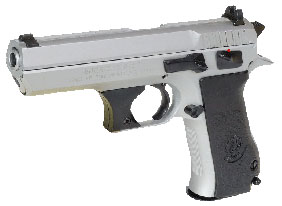
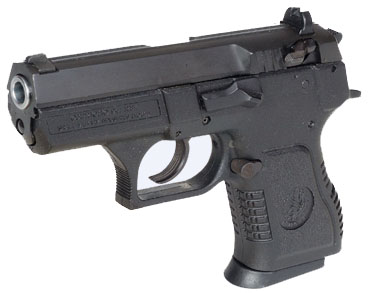
The Jericho 941 is a double action, semi-automatic pistol developed by Israeli Weapons Industries in 1990 as a smaller caliber alternative to their famous " Desert Eagle" magnum semi-automatic pistol. As initially marketed in America by O. F. Mossberg & Sons it was called the "Uzi Eagle," and was renamed the "Baby Eagle" by its current importer, Magnum Research, Inc., to create more affinity with their Desert Eagle, another design made by IMI and sold by Magnum Research. The Baby Eagle and Desert Eagle have little in common in design, but both represent very solid commercial efforts by the company responsible for the famous Uzi and Galil designs. |
| |
| |
| |
|
| |
| |
| |
Variants |
| |
JERICHO 941F
Basic model, slide mounted safety, double action, decocking mechanism. |
JERICHO 941F
Basic model, frame mounted safety (F), double action. |
| |
|
JERICHO 941FS
Short model (S), frame mounted safety (F), double action. |
JERICHO 941FB
Baby model (B), frame mounted safety (F), double action. |
| |
|
JERICHO 941FBL (Polymer)
Baby model (B), frame mounted safety (F), double action. |
JERICHO 941PS (Police Special)
Frame mounted safety, single action with compensator. |
| |
|
JERICHO I.P.S.C.
Frame mounted safety (F), single action for competition, 3 chambers, compensator. |
|
|
| |
| |
The introduction of the Jericho 941 also introduced a new caliber to the market, the .41 Action Express (or .41 AE), which was developed in 1986. The .41 AE was a unique rebated rim cartridge designed to use .410 inch (10.25 mm) bullets and duplicate a reduced power police loading of the .41 Magnum. The Jericho originally shipped with two barrels, one for 9x19mm Parabellum and the other for .41 AE. The magazine was designed to feed either round, and since the .41 AE was designed with a rebated rim the same dimensions as that of the 9 mm, the extractor and ejector worked equally well for either cartridge.
Soon after its commercial introduction, the .40 S&W was introduced to the market. Ballistically, the .40 S&W was nearly identical to moderate .41 AE loads (the reloading manuals that list the .41 AE generally say to use .40 S&W data), although commercial loadings of .41 AE were somewhat more powerful than the .40 S&W. With the stronger backing of major American firearms and ammunition manufacturers, the .40 S&W quickly pushed the .41 AE out of the market. The Jericho 941 was only on the market for 1 year before the dual 9 mm/.41 AE chambering was dropped, and the pistol was sold as either 9 mm or .40 S&W. Some shooters like the Baby Eagle in .40 S&W for its extra reserve of strength, since the Baby Eagle was originally designed for a more potent cartridge (the .41 AE), which is the reverse of some makers who dropped .40 S&W barrels into pistols previously spec'd for the milder 9mm cartridge and had subsequent barrel and cartridge case failures (kabooms).
A later compact version, the Jericho 945, was chambered in .45 ACP or 9 mm. It is not clear to what extent the Jericho original 41. AE/9mm Jericho frame and slide were "built-up" to handle the .45 ACP's much larger diameter; although the .45 ACP is a milder load running at much lower pressures than the .41 AE, the barrel opening for the .45 ACP is, of necessity, much larger. Desert Eagle does not permit the use of +P or +P+ loads per its website FAQ, although reviewers have shot and reported the ballistics on +P .45 ACP defensive loadings.
IMI eventually dropped the "Jericho" name in the American marketplace, and renamed the line of pistols "Baby Eagle", to capitalize on the cosmetic resemblance to IMI's more popular and well known Desert Eagle pistol line.
Initially Baby Eagle pistols used barrels with polygonal rifling, which sometimes produces slightly higher fps (feet per second) due to better bullet to barrel fit. IMI switched to conventional land and groove rifling from 2005 to 2007.
The Jericho 941 is issued in current service throughout the Israeli Security Forces.
The current production Baby Eagle lineup includes full size, semi-compact and compact models with both steel and polymer frames. |
| |
| |
|
| |
| |
| The .41 AE Cartridge |
| |
While the .41 AE and the easy caliber conversion it provided was a good idea, the timing was just not right. The .41 AE used the same bullet diameter as the never very popular .41 Magnum, and since the .41 Magnum was primarily a revolver cartridge (though IMI did offer it in the Desert Eagle for a brief time) not all .41 Magnum bullets were suited to an autoloading design. The powerful 10 mm Auto cartridge, which had been suffering from poor acceptance from its start in the early 1980s, was eventually accepted by the FBI in a reduced power, subsonic loading. Smith & Wesson then decided that the 10 mm Auto was too much cartridge for the reduced power loading, and that the .45 ACP sized guns that chambered it were too heavy and bulky; out of this came the .40 S&W, a shortened 10 mm Auto case, designed to fit in a 9 mm sized gun, with a reduced pressure loading that allowed a lighter, easier to shoot gun. The near identical ballistics of the .40 S&W and the .41 AE are a result of convergent evolution in engineering; the .40 S&W starting from 10 mm Auto and moving to a shorter 9 mm length case and matching the ballistics of a reduced 10 mm Auto loading, and the .41 AE starting with a 9 mm and moving to the .41 caliber diameter to match a reduced .41 Magnum load.
In 1988, IMI also developed a 9 mm Action Express, which was a .41 AE necked down to 9 mm. It offered a much larger case capacity than the standard 9 mm case, allowing velocities that matched that of the .357 Magnum when loaded with light bullets. This move anticipated the parallel development of the .357 SIG from the .40 S&W in 1994.
While the .41 AE was doomed by circumstance to obscurity, the concept of using a rebated rim to allow easy cartridge interchangeability was not lost. The .50 Action Express, developed by IMI for the Desert Eagle pistol, uses a similar rebated rim that is the same diameter as the .44 Magnum. This allows a caliber change with replacement of just the barrel and magazine. Bottlenecked pistol cartridges, which also allow caliber changes with just a barrel change, have also started become available; Sturm Ruger made a limited edition convertible P Series pistol in 9 mm/.30 Luger, Sig Sauer released the 357 SIG, based on the .40 S&W, and Cor-Bon released the .400 Corbon based on the .45 ACP. |
| |
Polymer Frame
|
| |
Steel Frame
|
| |
| |
| |
|
| |
| |
| |
Models |
941 F/R |
941 FS/RS |
941 FB/RB |
caliber |
9x19 |
40S&W |
9x19 |
40S&W |
45ACP |
9x19 |
40S&W |
Operation |
Semi-auto, short recoil system |
Locking system |
Lugs to slot (lugs on the barrel to slots in slide) |

Trigger mechanism |
Single or double action |
Decoker mechanism |
F, FS,FB - No R,RS,RB - Yes |
Firing pin block |
Yes |
Weight [gr] |
Pistol w/o magazine |
1000 |
900 |
900 |
1025 |
860 |
Magazine empty |
90 |
90 |
100 |
|
85 |
Loaded magazine |
282 |
258 |
282 |
258 |
310 |
250 |
230 |
Dimensions [mm] |
Overall length |
207 |
184 |
184 |
Height |
140 |
140 |
125 |
Width |
35 |
35 |
35 |
Barrel length |
112 |
90 |
90 |
Trigger reach |
76 |
76 |
76 |
Sight line radius |
150 |
134 |
134 |
Magazine capacity |
16/15 |
12 |
16/15 |
12 |
10 |
13 |
10 |
Twist 1 turn [mm] |
254 |
407 |
254 |
407 |
407 |
254 |
407 |
Rifling |
6 RH grooves. Polygonal grooves - optional. |
Trigger pull force |
S.A. 1.8 - 2.3 Kg. |
Sights |
Combat type, tritium sight - optional |
|
|